Maiden Voyage
April 10, 1912, Wednesday, Southampton, England - Sailing Day…
-Passengers arrive at the White Star docks and board Titanic between 9:30 - 11:30 am. Titanic casts off to depart on her maiden voyage promptly at noon. She was assisted by six tugs into the channel of the River Test. Under her own power, she passed two smaller ships moored on her left. The ships were White Star’s Oceanic and the American Line’s New York. The ships were warped together with New York on the outside.
As Titanic steamed past at six knots the lines that moored New York to Oceanic suddenly snapped. Now free of her moorings, New York began to drift toward the much larger Titanic. Disaster was averted when the tug Vulcan rushed to New York’s side and passed a line to her stern, slowing her drift toward Titanic. At the same time Captain Smith increased power to his port engine, causing a wash that helped push New York clear.
-The incident bears a remarkable resemblance to an earlier incident involving Olympic, with Captain Smith in command, and the Royal Navy Cruiser HMS Hawke, while outbound from Southampton on September 20, 1911. Navigating a narrow body of water called Spithead, off the isle of Wight, Olympic and Hawke were on a parallel course about 200 yards apart and on roughly the same course with Hawke off Olympic’s starboard side. Suddenly Hawke appeared to turn hard to port and rammed Olympic in the starboard quarter, badly damaging Hawke’s bow and creating a double gash in Olympic’s hull as well as damage to her starboard propeller. Olympic managed to limp back to Southampton and then to Belfast, where she underwent six weeks of repairs.
The courts later faulted Olympic for the accident. The decision was based on tests conducted by the Admiralty using small models in tanks to demonstrate the unseen hydrodynamic forces at work. Force’s, claimed the Admiralty, that literally sucked Hawke into the side of Olympic due to the immense size of the liner. Olympic had a gross tonnage of 45,000 tons, while Hawke was only 7,500 tons.
Rather than being punished for the incident, Captain Smith was instead promoted. He was named to command White Star’s new flagship, Titanic, on her maiden voyage to New York and back. This maiden voyage was to be Captain Smith’s last command as he planed to retire upon returning to England.
After finally making open water, Titanic turns toward Cherbourg, France, arriving at 6:35 PM. Here she takes aboard mail and another 274 passengers. Of these, 142 are first-class and include such names as Charles M. Hays, president of the Canadian Grand trunk Railroad; John B. Thayer, president of the Pennsylvania Railroad; Mrs. James Joseph (Margaret) “Molly” Brown, who was never actually called Molly until after her death; and Benjamin Guggenheim, who had originally booked passage on Lusitania but, when Lusitania became laid up for repairs, transferred to Titanic.
Titanic left Cherbourg at 8:10 PM en route to Queenstown (now Cobh), Ireland, where she arrived around noon. At Queenstown she takes aboard 120 additional passengers and 194 sacks of mail. A few passengers got off the ship here, including Francis Browne, a Jesuit Priest who took many of the only surviving photos of Titanic’s maiden voyage including the last known photo taken of her before the disaster, and Fireman J. Coffy, who deserted by hiding under sacks of mail being transferred ashore. From- Queenstown, Chief Officer Wilde posted a letter to his sister stating, “I still don’t like this ship … I have a queer feeling about it.”
At 1:30 on the afternoon of April 11, 1912 Titanic departed what was to be her final port of call and steamed steadily toward her date with destiny. As she sailed away Reverend Brown took one last photo of her.
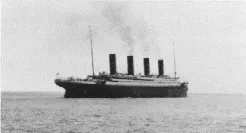
The last known photograph of Titanic, taken by Francis Browne as she steamed away from Queenstown on 11 April 1912.
Titanic encountered no rough seas or bad weather during the voyage and passengers quickly settled into their shipboard routines. On April 12, at around sunset, Titanic received the first warning of danger ahead. The French liner La Touraine sent a wireless message reporting ice ahead. The message was given to Captain Smith who gave it to Fourth Officer Boxhall. Boxhall noted the position on the map in Titanic’s chartroom. It was more than a thousand miles away and to the north of Titanic’s course.
Late on the evening of April 13 the Furness Withy liner Rappahannock, which was eastbound from Halifax to London, passed within signaling distance of Titanic and warned by signal lamp of heavy pack ice ahead. Rappahannock also reported that she had dented her bow and twisted her rudder in the encounter with the ice.
Titanic received a total of six separate ice warnings on April 14, the first coming at 9:00 AM from the Cunard liner Coronia. The message reported, “bergs, growlers, and field ice in 42°N, from 49° to 51°W.”
The second warning came at 11:40 AM from the Dutch liner Noordam, who reported “much ice” in roughly the same position. At 1:42 PM the third warning of the day came from the White Star liner Baltic. The message reported, “icebergs and large quantity of field ice in 41°51´N, 49°9´W.” This warning placed the ice only 250 miles ahead of Titanic’s position.
At 1:45 PM, just minutes after the warning from Baltic, the day’s fourth warning was received from the German liner Amerika, that reported passing two icebergs at 41°27´N, 50°8´W. This message was not actually intended for Titanic. It was addressed to the U.S. Hydrographic office in Washington. This was not within the range of Amerika’s own wireless, so Titanic relayed the message.
The fifth warning was received at 7:30 PM from the Leyland liner Californian. She reported her position as 42°3´N, 49°9´W, and reported, “Three large bergs five miles to southward of us,” only 50 miles ahead of Titanic’s current position.
The sixth and final warning came at 9:40 PM from the Atlantic Transport liner Mesaba who reported, “Lat. 42°N to 41°24´N, Longitude 40°W to 50°30´W, saw much heavy pack ice and great number large icebergs, also field ice.” Had anyone checked, they would have discovered that this last message described a rectangle that Titanic had already passed into.
Altogether, the six ice warnings received on April 14 described an area of ice 78 miles long. Unfortunately, there is doubt about whether the messages were ever delivered to the bridge or plotted on the chartroom map. Apparently not, since no one seems to have made the connection
Advertise on titanic.com
Please support our sponsors
Titanic webboard - Click here
-= Home =-
Californian
The Leyland liner Californian, steaming west from London to Boston without any passengers onboard, had stopped for the night after encountering a large field of ice. The ship’s master, Captain Stanley Lord, thought waiting till daylight to navigate this obstacle to be the most prudent thing to do. The ship’s only wireless operator, Cyril Evans, noticing the ship had stopped, went to see if all was well. He was informed by Captain Lord that they had stopped because of the ice. He asked Evans if he had any ships near-by. Evans responded, “Only the Titanic.” Captain Lord then told him, “Better advise him we are surrounded by ice and stopped.”
At 11:05 PM Evans sent the message to Titanic, “Say, old man, we are stopped and surrounded by ice.” His reply from Titanic, “Shut up, shut up, I am busy; I am working Cape Race.” With that Evans turned his radio off and retired for the night.
At around 11:00 PM Third Officer Charles Groves, who had the 8:00 - 12:00 watch, noticed the lights from a ship come up from the southwest. Around 11:40 he noticed the ship seemed to put out some of her lights. At 11:45 Groves and Captain Lord conferred about the ship, but couldn’t agree on what kind of ship it was. Lord thought it was a medium sized freighter, like themselves, about five miles away. Groves, on the other hand, thought it was a large passenger liner maybe ten miles away. Lord left instructions for Groves to call the other ship up on the Morse lamp and then retired below.
Groves tried calling the other ship until midnight when he was relieved by Second Office Herbert Stone. Groves pointed out the other ship to Stone and told him of his unsuccessful attempt to contact her. At 12:45 Groves left the bridge. He stopped by Cyril Evans’ cabin, where he liked to play with the wireless, but found Evans off-watch and asleep. Not knowing how to activate the receiver, he fiddled with the knobs and then left the cabin.
By now 20 year old apprentice James Gibson had joined Stone on the bridge and was also attempting to contact the other ship with the Morse lamp. At 12:40 Lord called the bridge on the speaking tube from his cabin and inquired about the other ship. Stone informed him that she was still in the same position as before. Lord then informed him that he was going to the chart room and “lie down a bit” on the settee.
Five minutes later Stone witnessed the first of eight rockets burst over the other ship. Though he wasn’t at first sure of what he saw, a second rocket soon burst over the other ship and he could clearly see the white stars streaming down from it. Over the next several minutes he witnessed three more rockets.
Stone called down the speaking tube to Captain Lord and informed him of the new twist regarding the mystery ship to the south. Lord wanted to know if they were company signals (before the days of radio ships from the same company would sometimes use colored rockets to communicate, with each color meaning something different). Stone informed the Captain that he wasn’t sure, but they were all white. Lord instructed him to continue trying to call her up on the Morse lamp.
All attempts at contacting her with the lamp failed, although Gibson thought at one point that she might be trying to signal back. After examining the ship through his binoculars, he decided that it must have just been her masthead light flickering.
At 1:40 Stone and Gibson witnessed an eighth and final rocket explode over the strange ship. Over another twenty minutes they continued watching and discussing what they were seeing. “A ship is not going to fire rockets at sea for nothing,” said Stone at one point. Gibson agreed and later stated that he felt the rockets indicated, “some sort of distress.”
Once, while the ship was still firing her rockets, Stone told Gibson, “She seems to look queer now.” Gibson observed the ship again through the binoculars and replied, “She looks rather to have a big side out of the water.” In other words, she appeared to be listing. Yet, they did nothing but continue to watch and discuss what it was they were seeing.
Around 2:00 the other ship appeared to be steaming away to the southwest and that she had fired eight white rockets in all. Gibson went to the chartroom and informed Captain Lord who replied, “All right. Are you sure there were no colors in them?.” Gibson stated that they were all white. Lord asked for the time and Gibson informed him that it was 2:05, “by the wheelhouse clock.”
At the subsequent inquiries Lord stated that he had no recollection of this conversation, stating that he had been sleeping soundly and only vaguely recalled Gibson opening the door. Gibson, however, stated that he was sure that Lord was awake.
At 2:40 Stone informed Lord, via the speaking tube, that the other ship was now gone. Again Lord asked if he was sure there were no colors in the rockets. Again he was informed they were, “just white rockets.”
At 3:30 Gibson and Stone began to see more rockets, further south and further away that the others. This was about the same time that Carpathia began firing rockets to reassure the survivors in the lifeboats that help was on the way. These rockets were not reported to Captain Lord.
Chief Officer Stewart relieved Stone on the bridge at 4:00. Stone recounted the sighting of the ship to the south, and the rockets, and the other rockets further south. When stone raised his binoculars he sighted a four masted ship with one funnel and, “a lot of lights amidships.” When asked if this was the ship that had fired the rockets, Stone informed him that this was a new ship he hadn’t seen before.
Later Stewart recalled that he had a feeling that “something had happened.” Yet, he did nothing until waking Captain Lord at 4:30 as Lord had asked. Stewart discussed the night’s events with Lord, but still nothing happened. Nothing that is until 5:20 when Stewart went to Evans’ cabin and woke him up. He told Evans that a ship had been firing rockets and asked to find out if something was wrong. Immediately, Evans got out of bed and turned on the wireless set. Within minutes he had the story. They were only 19 miles away from Titanic’s reported position.
Californian was underway around 6:00 - 6:15 and even though she had to slowly navigate three or four miles of field ice, she was at Titanic’s reported position by 7:30. The only other ship they found at that location was the Mount Temple. Neither ship found anything there.
Carpathia could be seen five or six miles to the east. By the time Californian had made her way to Carpathia it was 8:30 and Carpathia was just retrieving the last of Titanic’s lifeboats, #12. Californian stayed in the area and continued to search until around 11:00 and then continued on toward Boston having found nothing more than seven abandoned lifeboats and some light wreckage.
SearchAdvertise on titanic.com
Please support our sponsors
Titanic webboard - Click here
-= Home =-
The accident
April 14, 1912, 11:40 PM - The crow’s nest bell suddenly rings three times followed by the ringing of the crow’s nest telephone on the bridge. The telephone is answered by Sixth Officer Moody, who hears Lookout Fredrick Fleet’s urgent warning, “Iceberg, right ahead!” First Officer Murdoch, on watch on the bridge orders the engines stopped and then full astern and also orders the helmsman, Quartermaster Hitchens, to turn the helm hard astarboard.
For 37 seconds they waited. When it seemed as though they would strike the berg head-on, the ship finally started to turn to port (left), but it was too late. A spur of ice, hidden beneath the surface, bumped and scraped the starboard (right) side of the ship for a distance of 248 feet. This caused, not a continuous gash as once suspected, but a series of smaller holes and buckled hull plates that affected the first four compartments and two feet into the fifth. The total area now open to the sea was a mere twelve square feet.
Captain Smith, who was in his cabin just aft of the bridge on the starboard side, came immediately to the bridge. Upon learning of the collision with the iceberg the captain ordered Fourth Officer Boxhall to conduct an inspection of the ship. When he returned to the bridge Mr. Boxhall reported that he could find no damage at all. Within minutes however, reports to the contrary began to pour in - eight feet of water in boiler room 6, flooding in the mail room, twenty-five minutes after the collision the squash court was awash, fifteen minutes later the seaman’s quarters on E Deck forward, forty-eight feet above the keel, began taking on water. Edward Wilding, a naval architect at Harland and Wolff who’s primary job had been the design of Titanic, estimated at the British Inquiry that 16,000 cubic feet of water had entered the hull in the first forty minutes after the collision. Titanic was doomed.
Around midnight Captain Smith goes personally to the wireless room and orders First Wireless Operator John “Jack” Phillips to send a distress signal. Mr. Phillips dutifully sent the signal, “CQD” about half a dozen times followed by, “MGY” about half a dozen times. “CQD” was the distress signal used by the Marconi Company, by which Mr. Phillips and Second Wireless Operator Harold Bride were employed, and “MGY” was the wireless call-sign for Titanic.
The distress call was almost immediately answered by the North German Lloyd liner Frankfurt and shortly thereafter by the Cunard liner Carpathia. Carpathia was only 58 miles away and immediately turned around and headed toward Titanic at full speed. Carpathia, however, had a top speed of less than twenty knots and would take four hours to reach Titanic’s location. Captain Smith knows his ship will not last that long. He also knows that his lifeboats will only carry about half of the people on-board the ship. He also knows that the temperature of the sea water is only around 30° F. By this time he must have realized that he and half of the people on Titanic were under a death sentence.
At 12:05 the crew begins to uncover and swing out the lifeboats. At 12:25 the loading of the lifeboats begins with women and children loaded first. The loading and launching of the lifeboats is a slow and confused process as few of the crew and none of the passengers have had any formal lifeboat drills or been given lifeboat assignments.
At 12:45 the first lifeboat, number 7, is launched from the starboard side; with room for sixty-five people, it carries only twenty-eight. With only a slight list noticeable, passengers are hesitant to leave the imagined safety of the ship. The officers loading the boats are hesitant to fill the boats to capacity for fear of causing them to buckle while hanging from the davits. Harland and Wolff had tested the boats with the weight of seventy men, but none of the crew seem to have been aware of the test. About this time Quartermaster Rowe fires the first of eight distress rockets. A ship’s light is seen on the horizon to the north. The ship, thought to be the Leyland liner Californian, fails to respond to the flares or any other attempts to contact her.
By 1:15, the tilt on the deck growing steeper, passengers are now more willing to enter the small boats. Officers are now less cautious in loading the boats and they begin to leave more fully loaded. 1:40, with most of the forward lifeboats gone, passengers begin to move to the temporary safety of the stern.
At 1:40 Collapsible “C”, leaves the ship. As it is being lowered First Class passenger William Carter and White Star Managing Director J. Bruce Ismay step on-board. Ismay was later villainized for leaving his ship while over 1500 people were left to die. Ismay contended that there were no more passengers in sight when he boarded the boat. Carter later testified that he had placed his wife and children into a lifeboat prior to his departure in Collapsible “C”. It was determined at the British Inquiry that Mrs. Carter and the children had departed Titanic on lifeboat #4, fifteen minutes after Collapsible “C” left the ship. Mrs. Carter sued for divorce.
At 2:05 the last lifeboat is launched. There actually remain two collapsible boats, “A” and “B”, that are literally washed off the ship as she sinks and are not actually launched.
At 2:17 the last distress signal is sent by Titanic. In the early morning hours of April 15, 1912 Titanic became one of the first ships in history to send the new “SOS” distress call. About this time many passengers and crew are knocked or swept into the water as the bow quickly plunges under. The forward funnel collapses, crushing many of those struggling in the water.
At 2:18 the lights blink once and then go out for good. Several survivors report seeing the ship break in two between the third and fourth funnels. The bow section sinks and the stern settles back nearly level. Second Officer Charles Lightoller, who was in the water just yards from the ship, later reported that the ship did not break-up, but slid gracefully beneath the water in one piece.
At 2:20 the stern section, now filling with water, tilts into a position that is nearly perpendicular to the water’s surface and steadily sinks. 1500 people now struggle in the icy water. Most of the lifeboats that had rowed away from the ship with empty seats for fear of suction pulling them under when Titanic sank now refuse to return to the aid of those in the water for fear of being swamped. There they sat, listening to the screams of the dying, hearing the final pleas for help, “I know you can hear me, please save one life!” Many survivors later said they coped with this by convincing themselves that the screams and pleas they heard were not from their loved ones.
In less than an hour the sea is quiet. Finally, after it had quieted down, one lifeboat did return; lifeboat #14, under the command of Fifth Officer Lowe, rescued five swimmers. Lifeboat #4, under the command of Quartermaster Perkins, picked-up eight people, more because it was still close to the ship rather than because it returned.
Now those in the boats had nothing to do but wait…
Lifeboat Departures
| Time Launched | Boat # | Side of Ship | Capacity | Occupants |
|---|---|---|---|---|
| 12:45 | 7 | Starboard | 65 | 28 |
| 12:55 | 5 | Starboard | 65 | 41 |
| 12:55 | 6 | Port | 65 | 28 |
| 01:00 | 3 | Starboard | 65 | 50 |
| 01:00 | 1 | Starboard | 40 | 12 |
| 01:15 | 8 | Port | 65 | 39 |
| 01:20 | 10 | Port | 65 | 60-70 |
| 01:20 | 9 | Starboard | 65 | 56 |
| 01:25 | 12 | Port | 65 | 16-18 |
| 01:30 | 14 | Port | 65 | 63 |
| 01:30 | 13 | Starboard | 65 | 64 |
| 01:35 | 16 | Port | 65 | ? |
| 01:35 | 15 | Starboard | 65 | 70 |
| 01:40 | C | Starboard | 47 | 39 |
| 01:45 | 2 | Port | 40 | 26 |
| 01:45 | 11 | Starboard | 65 | 70 |
| 01:55 | 4 | Port | 65 | 29 |
| 02:05 | D | Port | 47 | 44 |
| 02:20 | A | Starboard | 47 | 13* |
| 02:20 | B | Port | 47 | 30* |
SearchAdvertise on titanic.com
Please support our sponsors
Titanic webboard - Click here
-= Home =-
The rescue
Of the more than 2200 men, women and children, passengers and crew aboard Titanic when she brushed up against the iceberg, only 705 survived. That’s only 32% of the people onboard the ship. Those who survived made it into the lifeboats and were picked up by the Cunard liner Carpathia later in the morning.
Carpathia, upon hearing of Titanic’s plight, immediately turned toward her. Running at full-speed, about 19 knots, she covered the fifty-eight miles of iceberg studded waters between them in just four hours.
Below is a chart of the numbers of people onboard, saved and lost. Everyone is broken down into Men, Women and Children, and Total. It’s then further broken down into passenger class and crew. The source for this table is the Senate Investigation Transcripts. Please note that I have corrected a couple of minor calculation errors regarding percentages. Also, the Senate came to the conclusion that there were 706 survivors, while the commonly accepted total is 705.
Percentages of Titanic Survivors by Class
On Board Saved Lost
Women and
Children
Men
Total
Women and Children
Men Total Women and Children Men Total
First
class 156 173 329 145
93% 54
31% 199
60% 11
7% 119
69% 130
40%
Second class 128 157 285 104
81% 15
10% 119
42% 24
19% 142
90% 166
58%
Steerage 224 486 710 105
47% 69
14% 174
25% 119
53% 417
86% 536
75%
Total Passengers 508 816 1,324 354
70% 138
17% 492
37% 154
30% 678
83% 832
63%
Crew 23 876 899 20
87% 194
22% 214
24% 3
13% 682
78% 685
76%
Total 531 1,692 2,223 374
70% 332
20% 706
32% 157
30% 1,360
80% 1,517
68%
Search